
2026.07 Research Release
A scientific AI workbench for data, models, and evidence.
BisQue Ultra connects complex scientific data, tool-guided computation, durable analysis, and evidence-gated model operations in one inspectable research environment.
Explore BisQue Ultra Read the launch brief Request research access
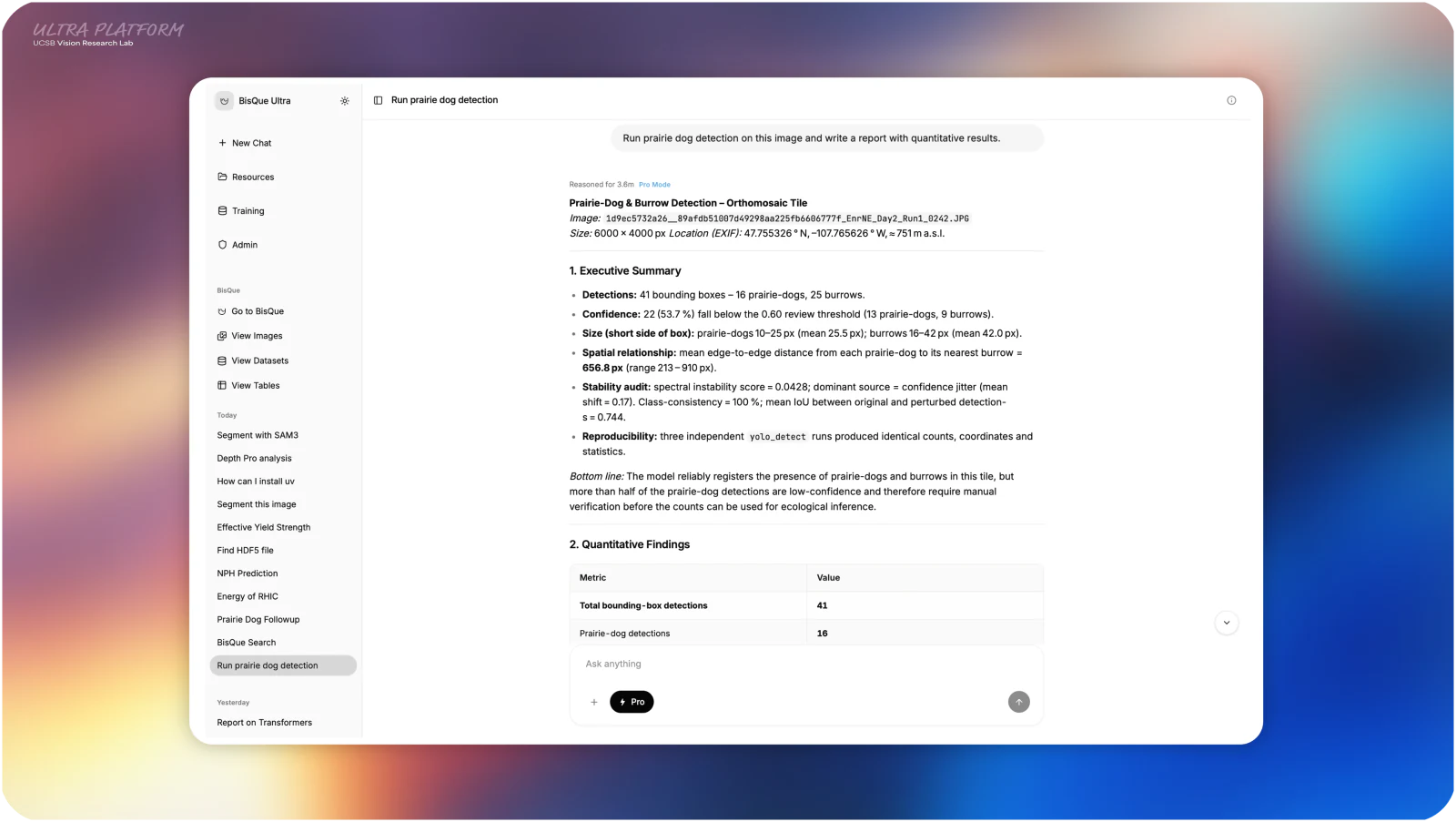
Today we are releasing BisQue Ultra 2026.07, a scientific AI workbench built for the full path from a difficult file to a reviewable result. Ultra opens the formats produced by scientific instruments, keeps multidimensional viewers close to the source, routes language into tools and models, persists long-running work, and preserves the figures, tables, metrics, reports, and run events that explain what happened.
Scientific AI should do more than produce an answer. It should preserve the conditions under which that answer can be inspected, challenged, and reused. BisQue Ultra treats the source data, the computation, the model, and the resulting evidence as parts of one durable record.
A model can change. The scientific record should not.
What is included
The 2026.07 release makes the scientific workflow visible end to end.
Scientific data as a first-class object
A dedicated image service opens more than 90 scientific formats and supports large tiled images, z-stacks, scalar volumes, HDF5 resources, video, and instrument metadata without flattening them into generic attachments.
Durable, inspectable analysis
Tools, code, models, papers, reports, figures, tables, source files, and run events remain attached to the same analysis record, even when work outlives a browser session or worker process.
Gold-gated model operations
Teams can freeze a gold set, retrain, follow live progress, benchmark a candidate, reject regressions, route a canary, promote an active version, and roll back. Newer weights are not treated as better until the declared evidence says they are.
Open, replaceable infrastructure
The local stack separates scientific resources, durable run control, worker execution, model serving, and the React workbench. An existing BisQue deployment is optional, and the worker can use an OpenAI-compatible model endpoint.
Built for the files and failures of real research
Scientific work rarely fits inside a single request and response. It includes file staging, visual inspection, tool selection, code execution, model calls, generated artifacts, and review. Browsers refresh. Workers restart. Services move. Ultra keeps the work recoverable through those ordinary failures while maintaining a legible path back to the data and decisions that produced each result.
The release also includes evidence-aware domain tools across imaging, ecology, microscopy, papers, chemistry, and bounded materials workflows. These tools retain their own data contracts, validation logic, and evidence boundaries. Where a required solver, dataset, or validation record is absent, the system is designed to fail closed rather than substitute an unsupported result.
Explore the release
Read the product through the systems that make it credible.
Start with the launch page, then go deeper on scientific imaging, model operations, research evidence, the BisQue foundation, and interface design.
- BisQue Ultra product page
- BisQue Ultra 2026.07 launch brief
- The scientific image engine behind BisQue Ultra
- From retraining to rollback: the GoldGate model lifecycle
- Evidence-aware materials research in BisQue Ultra
- The BisQue scientific image platform beneath Ultra
- Why the BisQue Ultra frontend looks the way it does
Work with us
We are opening BisQue Ultra to research teams working with complex scientific data, domain models, and reproducibility requirements. Tell us what you measure, what you need to run, and where the evidence currently breaks apart.
Request research access Run the local stack on GitHub Browse all project notes